Psychological Safety Is Not About Comfort
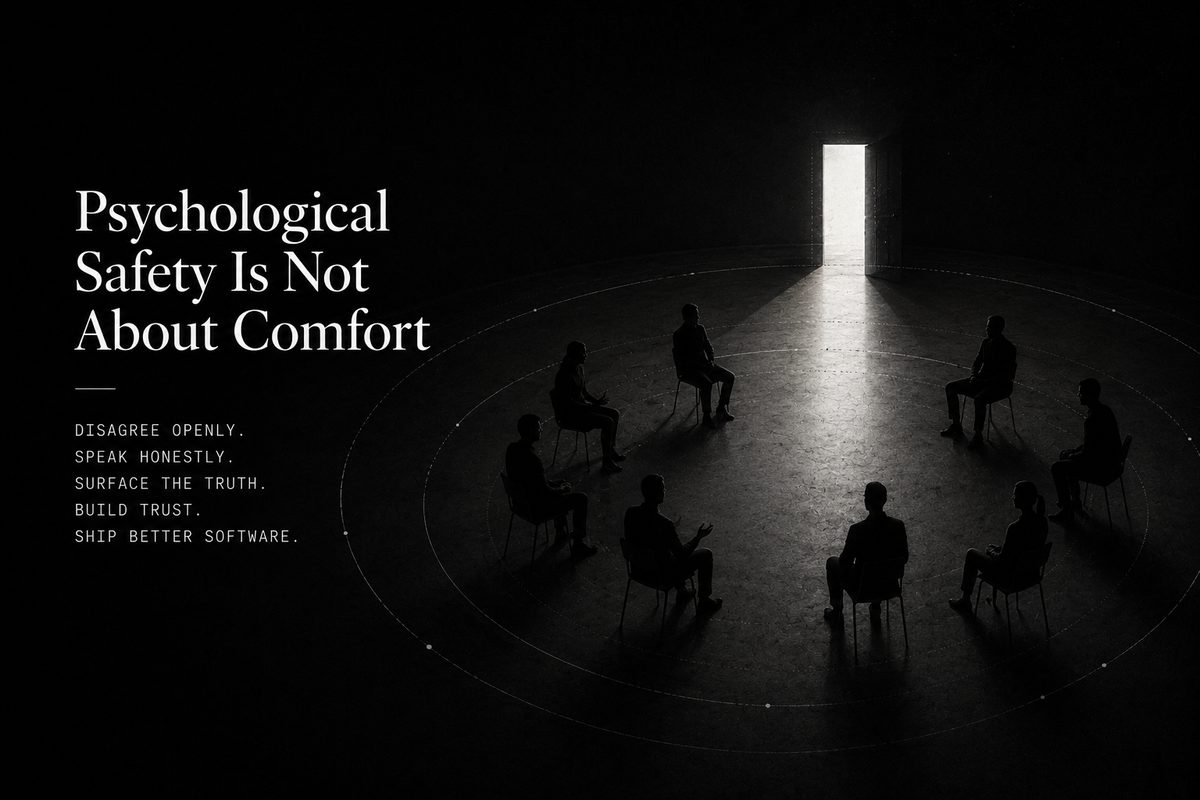
Somewhere along the way, a lot of organizations started confusing psychological safety with comfort. It’s not hard to understand how this happened. Many people have worked in environments where fear was normalized. Leaders publicly embarrassed people. Engineers learned to stay quiet in meetings. Mistakes became political liabilities instead of opportunities to improve systems. Entire organizations slowly optimized around self-protection instead of clarity.
Psychological safety emerged as a reaction to that, and in many ways, that shift was badly needed. But some organizations have drifted too far in the other direction. Discomfort itself started getting treated as evidence that something unhealthy was happening. In engineering organizations, that creates problems surprisingly quickly.
Healthy software development is often uncomfortable.
Good engineers challenge assumptions. Architectural disagreements happen. Priorities conflict. Tradeoffs are rarely clean. Technical debt forces difficult conversations. Feedback sometimes stings. Reality occasionally collides with ego.
None of that automatically means the culture is unsafe.
Some of the healthiest engineering environments are places where people disagree openly and directly on a regular basis. The difference is that the disagreement happens inside a foundation of trust rather than fear. That distinction matters.
Organizations sometimes become so conflict-avoidant that honest technical conversations start disappearing entirely. Engineers stop pushing back on questionable decisions because nobody wants to create “tension.” Leaders soften feedback until it becomes nearly useless. Teams quietly accumulate frustration because surfacing concerns starts feeling socially risky even in supposedly psychologically safe environments. Everything looks polite on the surface. Underneath, clarity slowly collapses.
One of the strange things about engineering culture is that avoidance often disguises itself as kindness for a while. Meetings stay pleasant. Nobody raises their voice. Feedback gets wrapped in layers of careful language. Leaders convince themselves they’re protecting morale. Meanwhile, important problems stop getting surfaced early. Eventually reality catches up anyway.
The difficult architectural decision still has to be made. The underperforming system still becomes unstable. The unclear ownership boundaries still create friction. The engineer who needed direct mentorship still struggles six months later because nobody wanted to have an uncomfortable conversation.
Avoidance rarely removes discomfort. It usually delays it while making the eventual cost larger. Psychological safety has less to do with comfort than with people being able to participate honestly without fear of disproportionate punishment. Those are very different things.
A psychologically safe engineering culture allows people to:
- admit uncertainty
- challenge assumptions
- surface risks
- ask naive questions
- acknowledge mistakes
- disagree openly
- change their minds
- say “I don’t know”
- deliver difficult feedback respectfully
That environment sometimes feels uncomfortable in the short term. Especially in organizations where people have learned that disagreement creates political danger. But long-term trust depends on that honesty. One of the clearest signals that an engineering culture is unhealthy is when engineers start routing around truth to preserve social stability.
You see it in subtle ways:
- concerns raised privately instead of openly
- polite agreement in meetings followed by frustration in side conversations
- engineers quietly compensating for broken systems instead of escalating them
- leaders hearing about problems only after they’ve already become expensive
At that point, the organization usually has an information problem disguised as a culture problem.
Remote work has amplified some of this dynamic.
Distributed teams often communicate through text first, which removes a lot of contextual nuance from disagreement. A direct technical critique that might feel completely normal in person can suddenly feel much sharper over Slack or Jira. Some organizations respond by avoiding directness altogether. That approach usually fails too.
Healthy remote cultures require even more intentional clarity, not less. More explicit ownership. More direct communication. More willingness to surface ambiguity early before it compounds quietly in the background. That doesn’t mean being harsh.
Some engineers still confuse bluntness with honesty. Those are not the same thing. “I’m just being direct” has become a convenient shield for a lot of emotionally immature behavior in technical environments. But clarity and kindness are not opposites.
Some of the best engineering leaders are capable of delivering very direct feedback while still making people feel respected and supported. Engineers know where they stand. Expectations are clear. Problems get surfaced early. Mistakes become learning opportunities instead of political events. That combination creates trust quickly.
A lot of organizations underestimate how much energy gets wasted when people stop communicating honestly. Teams become slower. Ambiguity spreads. Decisions lose clarity. Engineers start optimizing for self-protection instead of system health.
Eventually the organization becomes harder to reason about. Healthy engineering cultures are not cultures without discomfort. They’re cultures where people can move through discomfort together without fear that honesty itself will become dangerous.