Most Engineering Organizations Have an Observability Problem
Most engineers think observability is about systems. Logs. Metrics. Traces. But engineering organizations are systems too. As AI accelerates development, teams with poor visibility into themselves will generate chaos faster than ever.
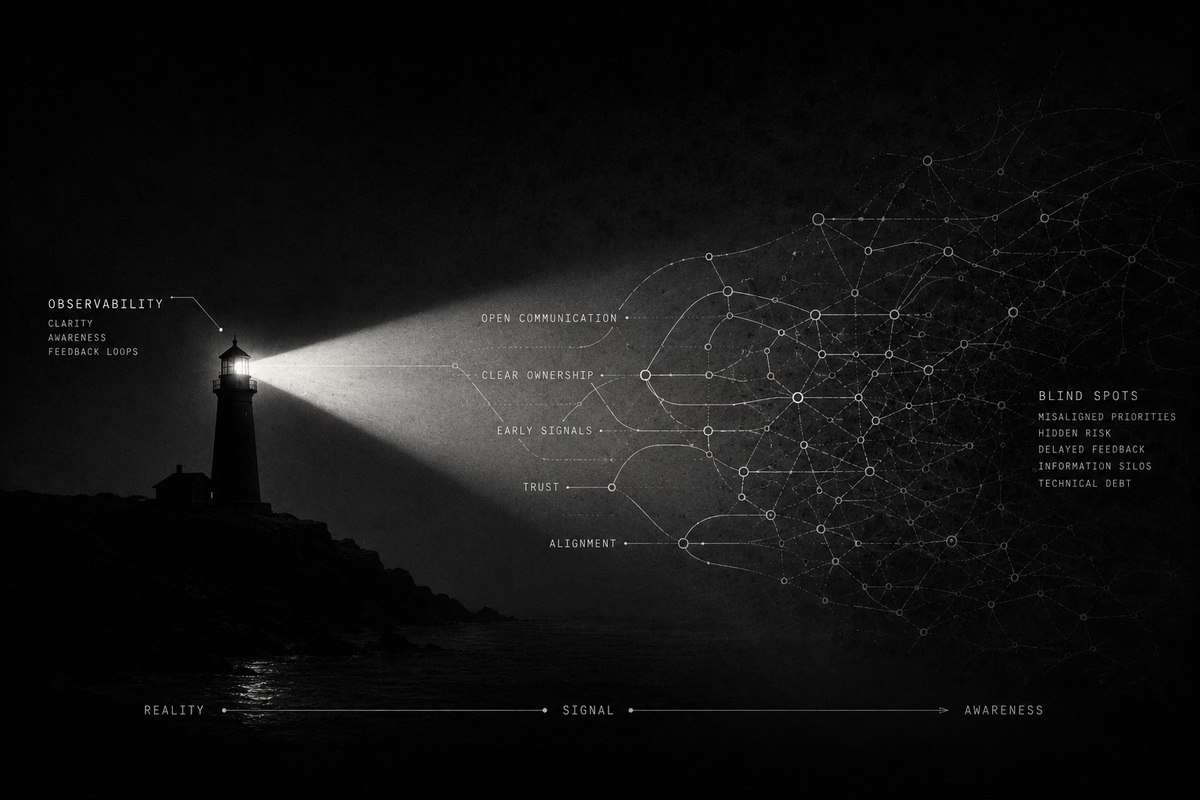
When most engineers hear the word “observability,” they think about systems.
- Logs
- Metrics
- Tracing
- Dashboards
- Alerts
The operational side of software. That’s obviously important. Modern systems are too distributed and too dynamic to operate reliably without good visibility into what’s happening inside them. Once systems reach a certain level of complexity, the old model of “wait for someone to report a bug” stops working.
You need instrumentation. You need feedback loops. You need visibility before failure becomes obvious. None of that is controversial anymore. What gets talked about far less is that engineering organizations behave the same way. A surprising number of software organizations are operating with almost no meaningful visibility into the actual state of the system they call “engineering.” And I don’t mean velocity metrics or Jira dashboards. I mean the real stuff.
- Can engineers safely surface uncertainty?
- Do teams actually understand ownership boundaries?
- Are architectural problems visible early, or only after outages?=
- Is technical debt being tracked honestly?
- Are dependencies understood?
- Can people disagree openly?
- Is information flowing cleanly between teams?
- Are problems discovered quickly or buried quietly until they become unavoidable?
Too many organizations are effectively trying to operate blind.
Over time, I’ve started thinking about engineering culture itself as a kind of distributed system. Information moves through it. Bottlenecks form. Signals degrade. Feedback loops break. Small failures compound quietly until eventually something large and painful becomes impossible to ignore.
The organizations that seem healthy on the surface are not always healthy internally. Sometimes they’re just very good at suppressing signals.
I’ve seen teams where everyone technically attended the same meetings, used the same tools, and followed the same processes, yet nobody had a shared understanding of what was actually happening. Leadership thought priorities were clear. Product thought engineering was aligned. Engineers thought ownership decisions had already been made somewhere else. Meanwhile, ambiguity just kept accumulating interest in the background.
The tricky thing about organizational observability problems is that they rarely announce themselves directly. They show up sideways. Roadmaps become unpredictable. Teams start missing obvious issues. Engineers become strangely hesitant to make decisions. Meetings multiply. Escalations increase. Simple work starts taking longer than anyone can explain. People begin optimizing for self-protection instead of clarity.
At some point, organizations start building process layers to compensate for the lack of visibility. More approvals. More coordination meetings. More status tracking. More reporting structures. Ironically, this often makes the visibility problem worse.
I’ve watched organizations become so overloaded with process and communication overhead that meaningful signals got buried under the weight of the system itself. Everyone was technically communicating constantly, but very little useful information was actually moving. This is part of why I’ve become increasingly skeptical of organizations that try to solve fundamentally human or structural problems entirely through process.
You can’t spreadsheet your way out of low trust.
You can’t create healthy feedback loops in an environment where engineers are punished for surfacing ambiguity or risk. Eventually people learn to route around discomfort instead of through it. The dashboards may still look healthy for a while, but the system itself starts drifting further from reality. In software systems, observability is valuable because it shortens the distance between failure and awareness. The same thing is true in organizations.
Healthy engineering cultures tend to detect problems early. Engineers surface uncertainty before it becomes catastrophic. Teams communicate architectural concerns before systems become brittle. Leaders receive uncomfortable information before it escalates into organizational damage. That only works when the environment allows truthful signals to travel upward without distortion.
I don’t think this is purely a leadership problem, either. Engineers contribute to organizational observability all the time, whether intentionally or not. Every time someone hides uncertainty, avoids conflict, silently works around broken systems, or declines to surface a concern because “it’s probably fine,” the organization loses visibility into itself. Sometimes understandably.
A lot of engineers have learned through experience that surfacing problems creates political risk while quietly compensating for broken systems gets rewarded as “being reliable.” That dynamic exists in more organizations than most leaders probably realize.
One of the strange side effects of AI-assisted development is that I think these problems may become even more visible over the next several years. As implementation speed increases, organizations with weak communication structures and poor feedback loops are going to accumulate chaos much faster. Ambiguity compounds faster under acceleration. Weak ownership models break faster. Architectural drift spreads faster.
The organizations that thrive are probably not going to be the ones generating the most code. They’ll be the ones capable of maintaining clarity while complexity increases.
Good observability has never really been about dashboards.
It’s about reducing the distance between reality and awareness. That turns out to matter just as much for organizations as it does for software.