AI Shortens the Reward Loop for Engineers
AI may not be changing software engineering primarily through productivity, but through momentum. By shortening the distance between effort and visible progress, AI copiloting restores flow states that years of complexity, tooling, and process slowly eroded.
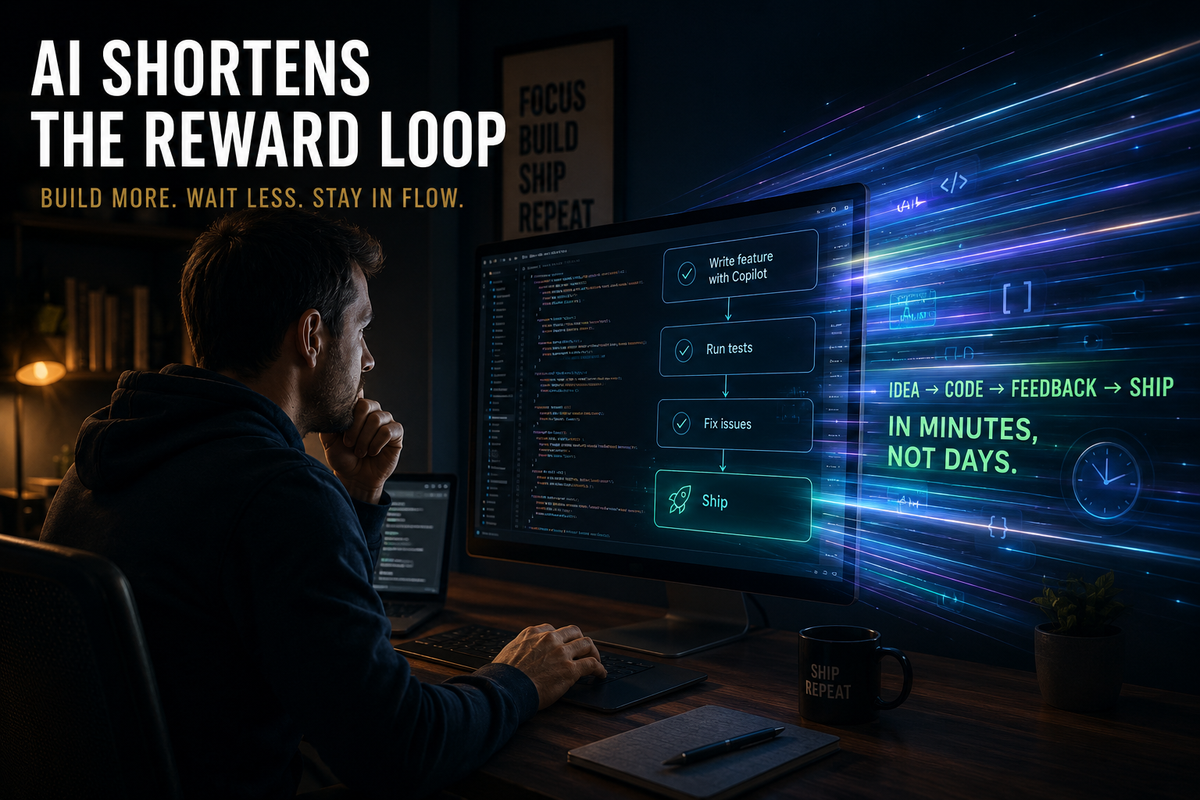
The most interesting thing about AI-assisted software development is not that it makes engineers faster. At least, I don’t think that’s the real story. Speed is measurable, so it dominates the conversation, but something more subtle has changed in the emotional experience of writing software. After spending the last year heavily integrating AI into my daily workflow, I’ve noticed that the biggest difference is not necessarily output. It’s momentum.
Traditional software development is full of delayed gratification. You spend hours or days holding partially completed systems in your head while fighting through implementation details, dependency issues, documentation gaps, infrastructure friction, unclear APIs, flaky tests, and the endless parade of tiny interruptions that fragment attention. Experienced engineers become accustomed to this to the point that we stop noticing it, but the cognitive cost is still there. Much of software engineering consists of maintaining psychological momentum while the environment constantly tries to break it.
That matters because motivation is often downstream of progress, not the other way around.
One of the reasons side projects die is not that people lose interest in the idea. It’s that the feedback loop between effort and reward becomes too long. You sit down after work already mentally exhausted, spend an hour fighting tooling or debugging some trivial issue, and end the night with little visible movement to show for it. Repeat that enough times and even exciting projects start to feel emotionally expensive.
AI dramatically compresses that loop.
The first time this really clicked for me, I was working on TattooSnap, a React Native application I’ve been building largely as a solo effort. In the past, implementing a moderately complex feature often involved a lot of invisible tax: hunting through documentation, scaffolding repetitive structures, translating concepts between frameworks, untangling TypeScript edge cases, and reconstructing context after every interruption. None of that work was intellectually satisfying. It was friction. Necessary friction sometimes, but friction nonetheless.
With AI copiloting integrated into the workflow, many of those tiny barriers started disappearing. Not completely, and certainly not reliably enough to blindly trust the output, but enough to preserve continuity of thought. Instead of stopping to spend twenty minutes recalling the exact shape of some obscure React hook pattern or Firebase query syntax, I could stay focused on the higher-level problem I was actually trying to solve.
That continuity changes the emotional texture of engineering work in ways I did not fully expect.
Ideas become cheaper to explore. Refactoring becomes less psychologically daunting. The activation energy required to start working drops substantially because the odds of immediately hitting frustrating dead ends decreases. Small wins accumulate faster, and those wins create momentum. Momentum creates engagement, and engagement creates the desire to keep going. There is a reason many engineers suddenly find themselves coding late into the night again for the first time in years. I do not think that is purely about productivity. I think it is about rediscovering flow states that modern software development slowly buried under layers of complexity and process.
The danger is that AI also creates the illusion of competence frighteningly well.
That same compressed reward loop can easily become a kind of slot machine for engineers. Prompt, generate, tweak, ship, repeat. The system constantly produces plausible-looking progress, and human beings are extremely susceptible to confusing movement with understanding. I’ve already seen developers fall into a pattern where they optimize for the emotional reward of generating code rather than the deeper work of understanding systems. The result feels productive right up until reality intervenes in the form of production incidents, scaling failures, security problems, or architectures nobody can reason about six months later.
In other words, AI does not eliminate engineering discipline. It increases the importance of it.
The engineers who benefit most from AI are usually not the ones treating it like magic. They are the ones with enough experience to recognize which parts of the work are genuine intellectual bottlenecks and which parts are simply friction. AI is extraordinarily effective at reducing friction. Boilerplate, translation work, repetitive implementation patterns, syntax recall, first-pass debugging, and exploratory scaffolding are all areas where these systems provide enormous leverage. What AI still struggles with are the things that actually make senior engineers valuable: judgment, tradeoff analysis, architecture, risk evaluation, prioritization, and operational thinking.
That distinction matters because it means AI is not flattening engineering expertise nearly as much as some people assume. If anything, it may be amplifying the gap between engineers with strong systems thinking and engineers without it. A disciplined engineer can use AI to dramatically accelerate execution while preserving quality. An undisciplined engineer can now create catastrophic complexity at unprecedented speed.
The optimistic interpretation is that AI gives developers something the industry has been systematically destroying for years: sustained momentum. After more than a decade of increasingly fragmented workflows, endless SaaS tooling, bloated frameworks, organizational overhead, and constant context switching, many engineers are finally experiencing what it feels like to remain in motion for hours at a time again.
That feeling is powerful. Possibly powerful enough to reshape the culture of software development itself.