AI Doesn't Reduce Technical Debt. It Changes the Cost of Discipline.
AI doesn’t reduce technical debt. It amplifies whatever engineering culture already exists. Strong teams move faster. Weak teams create chaos faster. The technology is impressive. The discipline behind it is what actually matters.
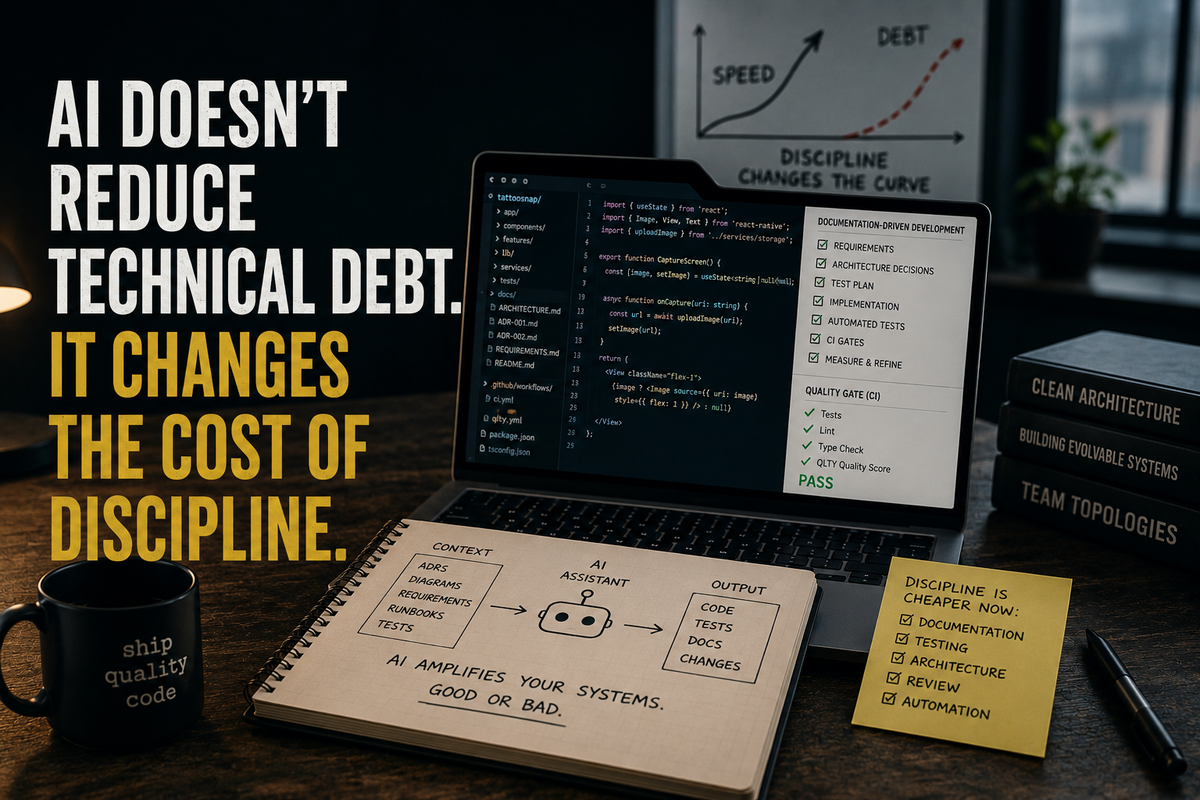
One of the most important thing AI has done for software development isn't code generation.It's making engineering discipline dramatically cheaper.
After spending the last year building TattooSnap with AI deeply embedded in the development process, I've become convinced that most of the current debate misses the point. AI doesn't eliminate the need for testing, documentation, architecture, or operational rigor. It changes the cost of maintaining those practices. That distinction may end up being one of the most important shifts in modern software development.
For most of my career, I've watched organizations treat engineering discipline as a luxury. Not because engineers didn't value it. Most engineers understand why automated testing, infrastructure automation, architecture documentation, and knowledge-sharing matter. The problem was never convincing people those things were useful. The problem was convincing them those things were worth the cost.
Maintaining good documentation competed directly with shipping features. Writing thorough tests slowed down the sprint. Rotating domain knowledge across a team felt less efficient than letting the expert handle it. Every act of discipline carried an immediate, visible cost — and the benefits were deferred, diffuse, and hard to quantify on a roadmap.
So organizations made a rational-feeling choice, over and over again: ship now, clean up later.
AI changes that calculation in a way I didn't fully anticipate.
While building TattooSnap over the past year, I found myself creating and maintaining documentation that would have felt prohibitively expensive only a few years ago. Product requirements, architecture decision records, system diagrams, onboarding documentation, workflow descriptions — all of it generated, reviewed, refined, and updated alongside the software itself.
The important part isn't that the artifacts exist. It's that maintaining them no longer feels like a separate job competing with development.
Historically, documentation suffered because it was written for future humans and maintained by current ones who had other priorities. It drifted from reality almost immediately and became difficult to trust. AI changes that equation in two ways: it lowers the cost of creating documentation in the first place, and it makes that documentation useful right now — as live context for the systems helping you build software today.
An AI assistant can review architecture decision records before proposing changes. It can compare implementation against documented intent. It can help engineers navigate unfamiliar domains without relying entirely on the one person who happens to remember why something was built a certain way. For organizations that have historically struggled with tribal knowledge, this is a genuinely meaningful shift.
But it's also where things can go badly wrong.
The same tools that make discipline cheaper also make indiscipline far more dangerous.
While building TattooSnap, I used AI to generate a significant amount of code quickly. Had I simply pointed a model at the project and accepted whatever it produced, the result would have been a mess. Instead, I built guardrails around the process — automated tests, CI pipelines, documentation standards, code quality feedback loops. Every change still had to survive scrutiny. The AI accelerated the work. It didn't replace the process.
That distinction is critical because AI is extraordinarily good at amplifying whatever system already exists around it.
If your engineering culture values testing, AI helps you write tests faster. If your culture values documentation, AI helps you maintain it more consistently. If your architecture has coherent boundaries, AI helps you extend them more reliably.
The inverse is equally true, and this is the part that doesn't get discussed enough.
If your organization tolerates poor testing practices, AI can generate untested code faster than any human ever could. If your documentation is stale, AI will confidently reason from incorrect context. If your codebase lacks coherent boundaries, AI will reproduce those inconsistencies throughout the system at speed. If your team's habit is to defer the hard decisions, AI will help you defer them at a scale that would have taken years to accumulate manually.
The model doesn't know the difference between a good habit and a bad one. It scales both.
This is why I've grown skeptical of conversations that frame AI primarily as a code generation problem. Most organizations that struggle with software delivery aren't suffering from insufficient output. They're suffering from unclear ownership, missing context, weak feedback loops, and incentives that reward short-term velocity at the expense of long-term maintainability.
AI doesn't solve those problems. In many cases it exposes them faster than the organization is prepared for.
The teams seeing the greatest benefit from AI aren't the ones abandoning engineering practices. They're the ones using AI to make those practices less expensive — so that discipline, for once, has a better return on investment than the shortcut.
For years, software organizations have been forced to choose between moving quickly and maintaining deep organizational memory. The tradeoff wasn't absolute, but it was real. Every layer of documentation, automation, and process carried a maintenance burden that competed with delivery.
Much of that burden is now shrinking.
That doesn't mean discipline matters less. It means there's finally a compelling economic argument for investing in it earlier, maintaining it more consistently, and treating it as a competitive advantage rather than an overhead cost.
The teams that recognize this will likely become dramatically more effective over the next several years. They'll use AI to strengthen feedback loops, preserve context, and automate the tedious work that previously crowded out good habits. They'll move faster precisely because the cost of maintaining healthy systems has dropped.
The teams that misunderstand the shift will reach a different conclusion. They'll use AI to maximize output while minimizing discipline. They'll generate more code, more complexity, more undocumented decisions, and more concentrated risk than ever before. For a while, they'll look incredibly productive.
Then the bill will arrive.
I've spent enough time in software to know that shortcuts often work in the short term — that's part of what makes them tempting. AI doesn't change that reality. What it changes is the scale at which those decisions compound, and the speed at which the interest accrues.
A disciplined team can now build faster than any disciplined team in history.
An undisciplined team can now accumulate debt at a pace that would have been almost impossible a few years ago.
The question was never whether AI can write code. The question is whether the organization using it has enough discipline to know when the code shouldn't be written, how it should be tested, why it exists, and what future engineers will need to understand after today's excitement has faded.
That question was important before AI.
It's more important now.